Widespread distribution of α-synuclein oligomers in LRRK2-related Parkinson’s disease
Hiroaki Sekiya
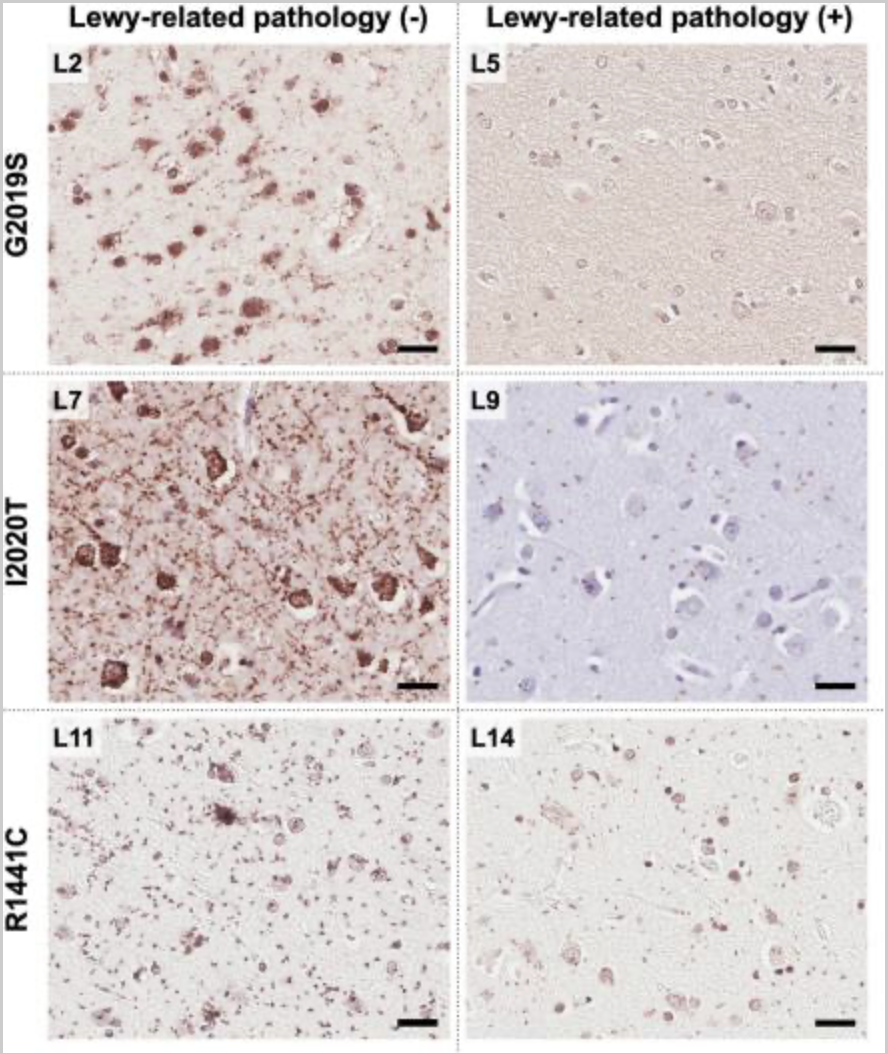
Mutations in leucine-rich repeat kinase 2 (LRRK2) are the most common cause of familial and sporadic Parkinson’s disease (PD). While the clinical features of patients with LRRK2-PD resemble those of typical PD, there are significant differences in the pathological findings. The pathological hallmark of definite PD is the presence of α-synuclein (αSYN)-positive Lewy-related pathology; however, approximately half of patients with LRRK2-PD do not have Lewy-related pathology. Lewy-related pathology is a late-stage αSYN aggregation that can be visualized with hematoxylin and eosin stains or conventional immunohistochemistry (IHC). Increasing evidence has indicated that αSYN oligomers, which represent the early-stage of αSYN aggregation, may have neurotoxicity. Visualization of αSYN oligomers requires specialized staining techniques, such as αSYN-proximity ligation assay (PLA). Distribution and severity of αSYN oligomers in the brain of patients with LRRK2-PD remain unknown. In this study, we performed phosphorylated αSYN-IHC and αSYN-PLA staining on postmortem brain sections of patients with three pathogenic LRRK2 mutants: p.G2019S (n = 5), p.I2020T (n = 5), and p.R1441C (n = 4). The severity of Lewy-related pathology and αSYN oligomers was assessed semi-quantitatively in the brainstem, limbic lobe, basal ganglia, and cerebral cortex. αSYN oligomers were detected in patients with LRRK2-PD even in those without Lewy-related pathology; a negative correlation was observed between Lewy-related pathology and αSYN oligomers (r = − 0.26 [− 0.39, − 0.12]; P < 0.0001). Our findings suggest that αSYN oligomers may represent a common pathological feature of LRRK2-PD. Notably, patients harboring p.G2019S and p.I2020T had significantly higher levels of αSYN oligomers in those without Lewy-related pathology compared to those with Lewy-related pathology. These patients also had a trend toward shorter disease duration. These results imply that in LRRK2-PD, αSYN oligomers may initially accumulate in the brain but do not progress to form Lewy-related pathology. The present study suggests that targeting αSYN oligomers may be a therapeutic strategy for LRRK2-PD even if there is no Lewy-related pathology.